
State-Specific Compliance
Certified Payroll and Prevailing Wage Compliance in All 50 States
Find Your State's Prevailing Wage Compliance Requirements
Nationwide Compliance for Your Projects
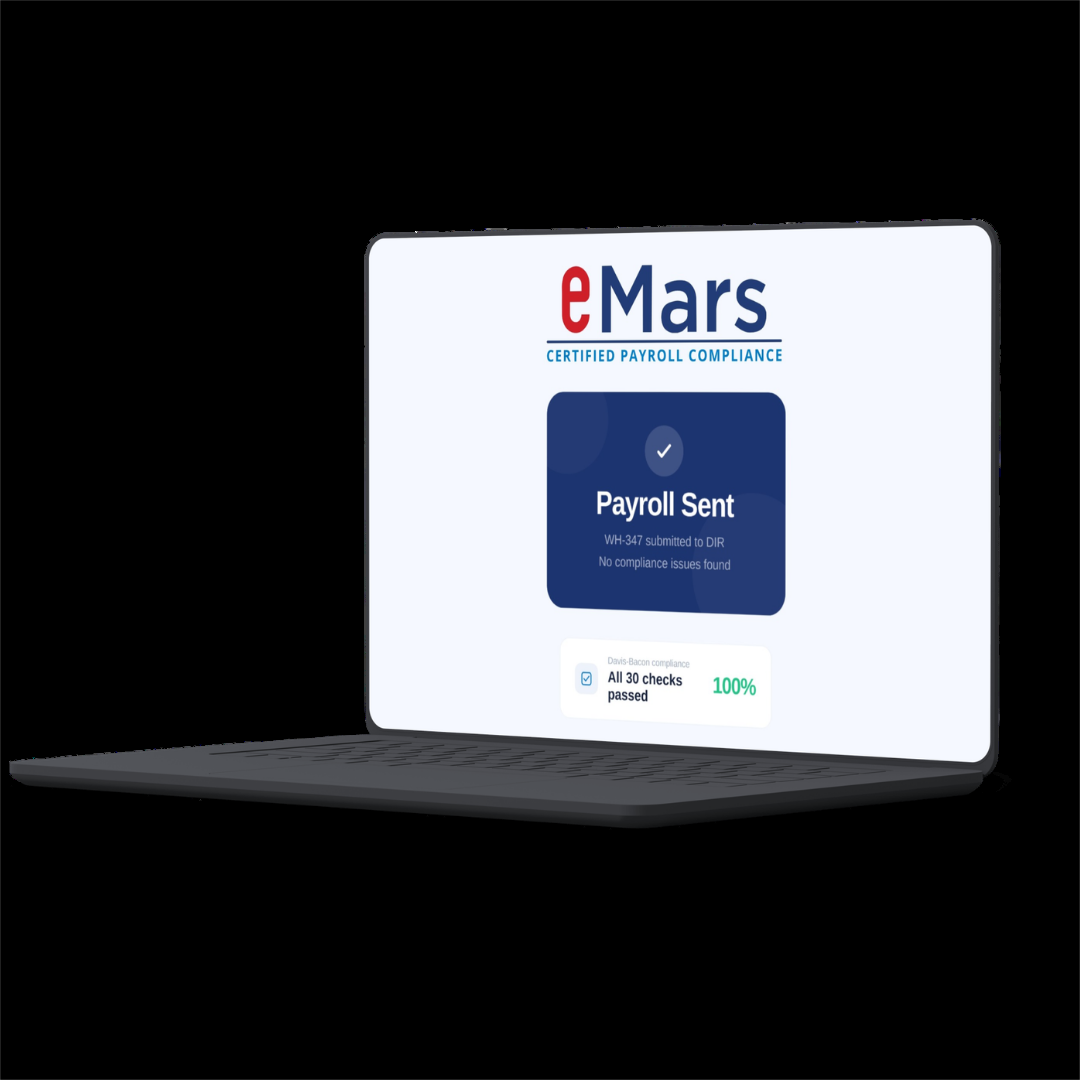
State-specific prevailing wage compliance requires contractors on public works projects to follow both federal Davis-Bacon Act standards and the individual labor laws of each state where work is performed. Thirty-two states maintain their own prevailing wage statutes, while others rely on federal requirements when projects receive federal funding. eMars supports certified payroll and compliance reporting in all 50 states, including XML auto-fill for California, Washington, and New York.
Support For All 50 States
XML auto-fill for CA, WA, NY
Updated for 2026 regulations (AB 889, SB 426, NJ data center rule)
How Federal and State Prevailing Wage Laws Work Together
The Davis-Bacon Act establishes the federal prevailing wage floor for any federally funded or assisted construction contract exceeding $2,000. State prevailing wage laws operate independently and apply to projects funded with state or local government dollars. When a project receives both federal and state funding, contractors must pay the higher rate for each worker classification, and certified payroll must satisfy both reporting requirements.
The 2024 Department of Labor final rule restored the three-step wage determination method for the first time in 40 years. A wage rate now qualifies as prevailing if it was paid to at least 30 percent of workers in a classification within a given locality, down from the previous 50 percent threshold. The change has led to higher prevailing wage rates in roughly 85 percent of the surveyed areas. The updated WH-347 certified payroll form took effect in January 2025, and the Department of Labor will accept the previous form through September 30, 2026.
Recent Regulatory Updates Affecting State Compliance
Several regulatory changes from 2024 through 2026 directly affect prevailing wage compliance. The DOL final rule restored the three-step wage determination method, expanded the scope of work definitions, and authorized multi-county project wage determinations. The One Big Beautiful Bill Act, signed into law on July 4, 2025, accelerated repeal schedules for most Inflation Reduction Act tax credits and compressed deadlines for projects to qualify. However, the IRA prevailing wage and apprenticeship requirements remain in effect for qualifying projects.
State-level updates have been active through 2026 as well. California enacted AB 889, requiring annualization of fringe benefits effective January 1, 2026. Oregon's SB 426 created joint and several wage liability across the contracting chain. New Jersey extended prevailing wage coverage to private data center projects exceeding 250 kilowatts effective April 1, 2026. New York transitioned to mandatory MPWR electronic certified payroll filing as of December 31, 2025.
How eMars Supports State-Specific Compliance
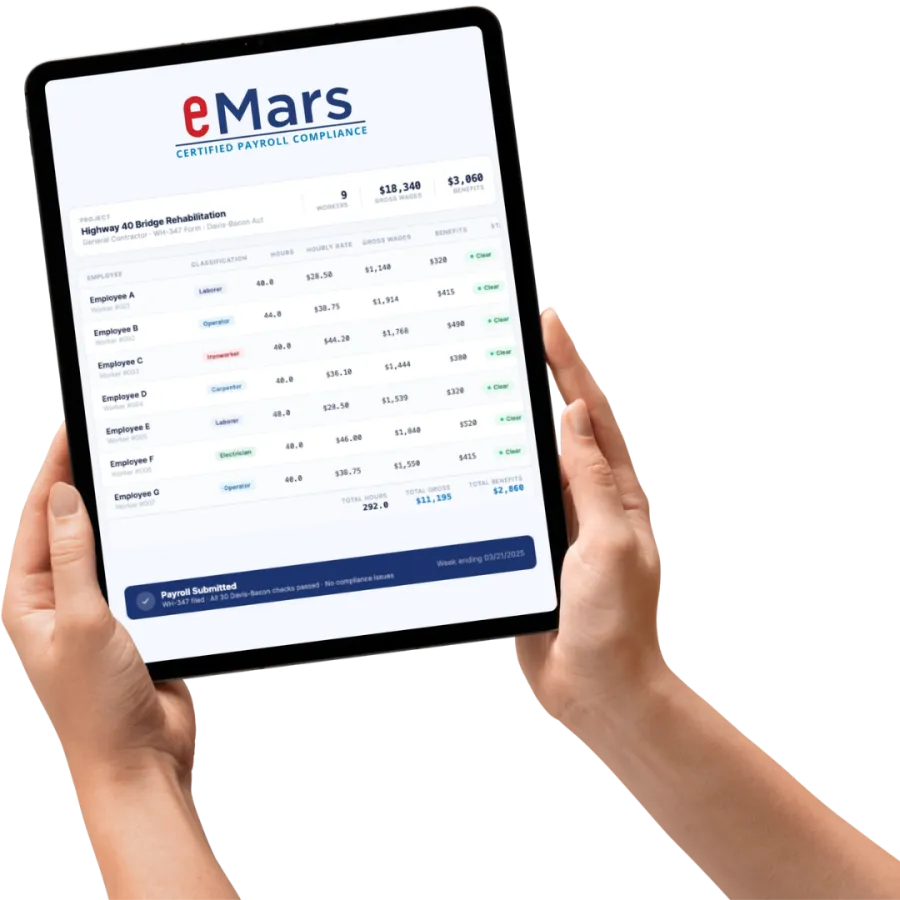
eMars has been processing certified payrolls since 1993, beginning with HUD housing construction projects and expanding to support contractors on federal Davis-Bacon work, state prevailing wage projects, and IRA tax credit qualifying facilities. The Compliant Client platform handles the full compliance workflow from payroll entry through certified report generation, with built-in validations that catch classification errors, fringe benefit miscalculations, and overtime issues before reports are submitted.
For state-specific filings, the platform produces fully populated XML files for California DIR, Washington L&I, New York, and AASHTO multi-state reporting, as well as state-specific forms for Oregon, New Jersey, and other jurisdictions.